How to read a reinforcement drawing
- Basit Haq
- Sep 12, 2023
- 2 min read

Reinforcement consists of steel bars which are cast into concrete to increase its tensile strength.
Checking if the correct reinforcement (or rebar in short) has been laid is very important as if there isn't enough, or it hasn't been laid correctly, it could lead to structural failure.
Reinforcement checks are done as part of a pre-concrete pour checklist and could be one of the first activities you're asked to do on site.
Below is a break down of how to read a typical reinforced concrete slab drawing.
These are relatively easier to understand and the logic can be applied to more complex reinforcement drawings.

What do the labels mean?
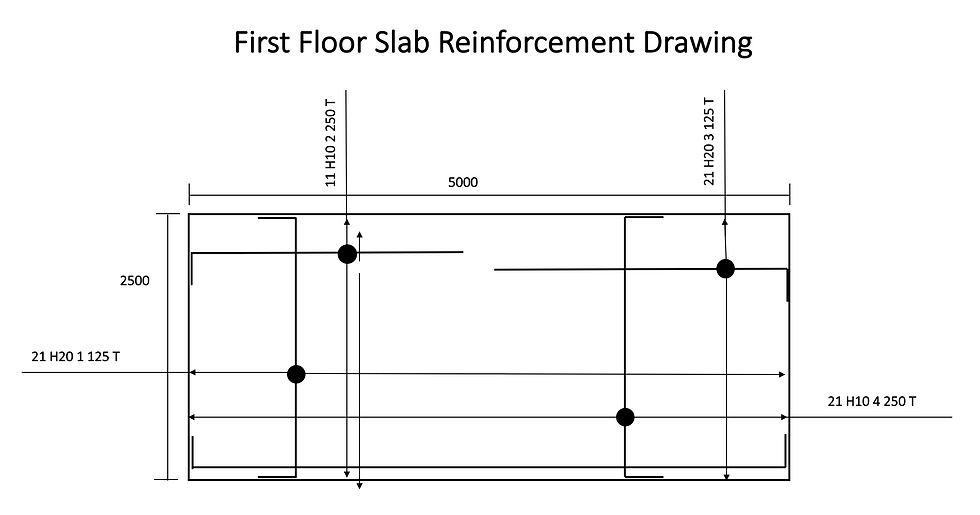
The first step is to locate the correct reinforcement drawing for the area you are inspecting.
In the case of a concrete slab it should look similar to the drawing above.
The number of bars you're looking at may be overwhelming but break it down into little chunks.
Steps to follow:
1. Look at one bar - these are the thicker lines on the drawing above
2. Locate the circle on the bar
3. Follow the less bold lines to the end of each arrow - this tells you where the bar you're looking at starts and ends
4. Look at the label at the end of the arrow
5. Use the multi coloured key above to see what each term means
6. Count the bars on site - check they are the correct number, diameter, shape and distanced correctly.
Bar Bending Schedule
The bar mark relates to a bar bending schedule. Each reinforcement drawing should be accompanied with a schedule.
This is in tabular form and tells you the shape of each bar, quantity, length, other dimensions and weight.
If you type 'bar mark shape codes' into an online search engine it will show you what shape each code relates to.

Steel fixers tying steel reinforcement bars together
Definitions
Tensile strength – the ability of a material to withstand stretching or pulling forces without breaking or undergoing permanent deformation. Measured in kN/m squared
Pre-concrete pour checklist - a quality checklist which is used to approve an element is ready for concrete to be cast
Posts to Follow
We plan to go into more details on Substructure and add sections on:
Health and Safety
Quality
Programme
Commercial
Please let us know if you found this post useful using the chat function. We'd love to hear from you - is there anything in particular you'd like for us to focus on next?


Thank you for this, very helpful! I have a specific question; how should one re-measure rebar following a design change? This is from a commercial perspective.